21 September 2014

‘Four’: A Map

I didn’t plan it this way, but since the discussion of the etymology of ‘four’ has unfolded into a small saga in several acts, I have to organise it for convenience. Here is a map of the route:

  1. [Word of the Month: Proto-Indo-European ‘Four’]
  2. [Even and Odd]
  3. [The Name of the Game: Jakobson Reads Vasmer]
  4. [Twos and Troops: Sifting the Evidence]
  5. [Forgotten Derivatives and their Sexual Implications]
  6. [Only Connect: The Strange Triangle]
  7. [Two Is Company, Four Is a Party] NEW!
The End

The Name of the Game: Jakobson Reads Vasmer

With the vast and reliable etymological material put into circulation by Vasmer, a number of new questions naturally arises. I should like to dwell on some particulars.
Roman Jakobson (1955) *) 

The Slavs played at “even and odd” too. In Polish the game used to be called cetno licho (or cetno i licho). The noun licho is still used as a mild euphemism for ‘devil’. Czego chcesz, do licha? means “What the heck do you want?” Polish also has the adjective lichy ‘poor, inferior, in bad shape’. Historically, licho is a neuter form of lichy, substantivised centuries ago, when the adjective had a wider range of meaning, including  ‘mean, evil’; licho was therefore ‘something wicked’. The phrase cetno i licho lingers on on the fringes of literary Polish (people are at best vaguely aware that it refers to some old game of chance), but cetno no longer occurs on its own, and has no obvious relatives  in the modern Polish lexicon.

The man who read Vasmer's dictionary
[source]
A few hundred years ago (most examples come from 16th-century texts) cetno and licho could mean, respectively, ‘even number’ and ‘odd number’. Though often contrasted with each other, they were not yet harnessed together into a fixed phrase. Cetnem (instr.sg.) or w cetnie (loc.sg.) meant ‘(occurring) in even numbers’; likewise lichem and w lichu ‘in odd numbers’. This usage has been completely forgotten.

Licho and lichy go back to Proto-Slavic *lixъ ‘strange, irregular, rogue’. In the modern Slavic languages it usually has pejorative conotations (‘bad, lacking, defective, lonely’, etc.); it can also mean ‘excessive, superfluous’. The meaning of Russian lixój, however, ranges – somewhat schizophrenically – from ‘bad, sinister, hard’ to ‘daring, valiant’ (the common ancestor was ‘extraordinary’, whether in a positive or a negative sense)’. Like semantically similar words in other languages (Greek perittós, English odd), *lixъ developed the arithmetical meaning of ‘odd’, which survives here and there in the Slavic branch. For example, in Czech liché číslo means ‘odd number’. As for its origin, *lixъ < *leikʷ-so-, from the widespread Proto-Indo-European root *leikʷ- ‘leave, abandon’.

So much for licho. Where does cetno come from? The Russian term for “even and odd” is čët i néčet. Čët means ‘even number’ (= čëtnoe čisló); néčet is its antonym. The adjective čëtnyj ‘even’ (of a number) is closely related to Polish cetno. Russian č normally corresponds to Polish cz, but some regional varieties of Polish have merged the affricate cz /tʂ/ with c /ts/ for centuries, and the standard language has borrowed a number of dialectal pronunciations of this kind.

On the combined evidence of Polish and East Slavic forms we can reconstruct Proto-Slavic *četъ (n.) and *četьnъ (adj.). Russian also has the noun četá ‘pair, couple’, which is formally and semantically close to them. There are several other Slavic words that might or might not be related to *četъ, but it’s wiser at this stage to exclude more difficult material so as to avoid the risk of contaminating a reliable set of cognates with spurious ones.

Back in the 1950s, as successive volumes of Max Vasmer’s monumental Russisches etymologisches Wörterbuch were published in Heidelberg, the great linguist Roman Jakobson (then at Harvard University) read the entire dictionary (I mean, actually read it like a novel, page by page), jotting down comments on entries that attracted his attention. Those marginalia were published as a journal article (see the reference below) and reprinted in Jakobson’s Selected Writings (Volume II: Word and Language). With regard to čët and its relatives, Jakobson remarked that they “seem to be archaic relics of the same word family as četýre” (the Russian reflex of the Indo-European numeral ‘four’). Having devoted one sentence to the matter, he moved on to the next entry that had caught his eye, čex ‘Czech’. The idea that čët and četýre are somehow related has been picked up by several other authors, but hitherto published attempts to analyse *kʷetwor- in this light have the usual flaws of “root etymologies”: too little attention to morphological details, and too much imaginative semantics. Nevertheless, I think Jakobson’s idea is worth salvaging, so I’ll review those previous attempts and try to see if I can do any better.

*) Roman Jakobson. 1955. “While reading Vasmer’s dictionary”. Word 11: 611-617.

[link to a digitalised Russian translation of Vasmer's dictionary]

[to be continued]

[back to the table of contents]

19 September 2014

Even and Odd

A brief interlude before we dissect *kʷetwor- for good:

This game is simple, and is played with marbles. One player holds in his hand a number of these toys, and demands of another whether that number is even or odd. If the guess is right, the guesser wins one; if wrong, he loses one.
Edgar Allan Poe, The Purloined Letter

Hellenistic ladies playing with astragaloi
(The British Museum)
This game is not only simple, but also as old as the hills. The Romans played it, and so did the Greeks and their gods. It was played with whatever could be concealed in one’s hand: astragaloi (“knucklebones”), nuts, coins, or pebbles. The game, in some ways ancestral to roulette, was called pār impār ‘equal-unequal’ in Latin. The Greeks called it artiasmós, or ártia ḕ perittà ‘even or odd’, or zugà ḕ ázuga ‘pairs or non-pairs’. It was so popular among the Greeks that a special verb, artíazō, was coined to mean ‘play at even and odd’.

Note that the Greek word for ‘even’ is ártios, meaning also ‘perfect, complete, exactly fitted’; it contains the highly productive Proto-Indo-European root *h₂ar- ‘fit together’, which has yielded, among many other Classical words of international currency, Greek harmonía ‘connection, framework’ (hence, figuratively, ‘agreement, order, harmony’) and Latin articulus ‘joint’. Similarly, Greek zugón ‘yoke’ (hence ‘pair’) < PIE *jugóm is derived from the root *jeug- ‘to yoke, connect’. The same root is the source of the Sanskrit words for ‘even’ (yugmán-) and ‘odd’ (a-yúj-, literally ‘having no yoke-fellow’). On the other hand, the core meaning of Greek perittós ~ perissós was ‘excessive, superfluous, extraordinary’. It seems that the notion of parity or “evenness” was understood as exhaustive divisibility into pairs rather than into two equal halves. To check if a number of things was even, you removed pair after pair until either nothing or a surplus of one was left. Such a remainder, or “odd man out”, was a kind of imperfection, marring the regularity of the number.

What has it got to with the etymology of ‘four’? We shall see next time.

[back to the table of contents]

17 September 2014

Word of the Month: Proto-Indo-European ‘Four’

As promised in a comment to my previous blog post, I’m going to discuss an etymological question: the origin and structure of the numeral ‘4’ in the Indo-European languages.

The Proto-Indo-European numeral ‘four’ had several intriguing properties. It was the largest non-complex cardinal number that agreed grammatically with a noun it modified. Consequently, it was inflected for gender and case, like any ordinary adjective. It shared that property with the words for ‘one’, ‘two’ and ‘three’. For obvious semantic reasons, their declension was defective: ‘one’ was normally singular, ‘two’ was declined only in the dual number, and ‘three’ and ‘four’ only in the plural.
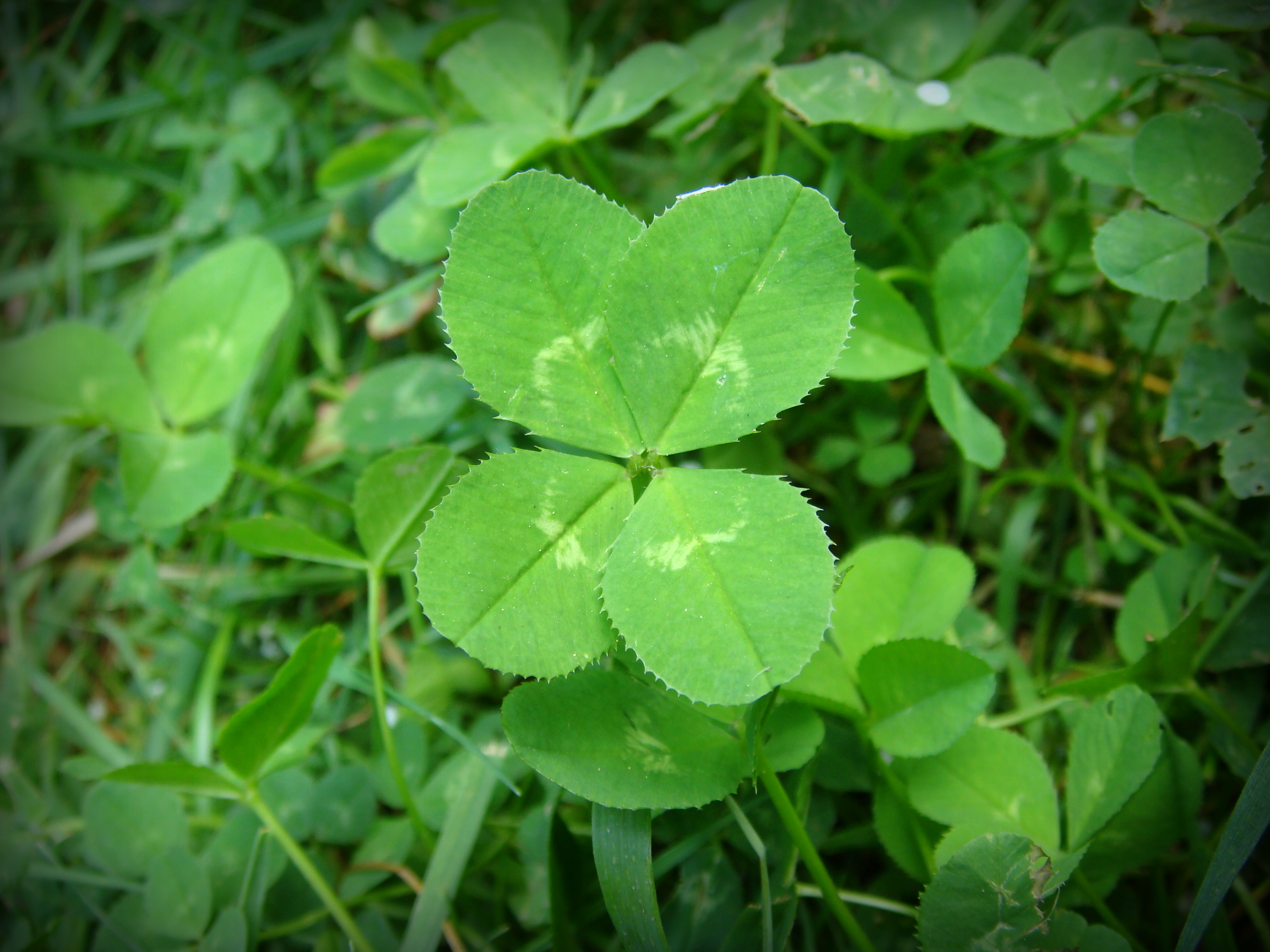
The fourth is for luck.
The basic forms of the numeral ‘4’ (as reconstructed in handbooks) were the animate “count plural” *kʷetwores and the inanimate (neuter) “collective plural” *kʷetwōr (from earlier *kʷetwor-h₂). There is some uncertainty about the accentuation of these forms: some reconstruct them with PIE stress on the first syllable, others on the second (the comparative evidence is not unambiguous).

Proto-Indo-European probably had no feminine gender as a formal category, but it had ways to express femininity in derivatives. Curiously, the numerals ‘three’ and ‘four’ seem to have had feminine forms, preserved only in Celtic and Indo-Iranian. They are reconstructed as *tisres ‘3’ and *kʷetesres ‘4’. The final *-es is the familiar nom.pl. ending of animate stems ending in a consonant, but the rest looks baffling. The suffix *-sr-, known also from the Anatolian languages, where it forms nouns denoting human females, probably reflects an archaic, almost completely abandoned word for ‘woman’ (*ser-), although the zero grade (absence of a vowel) in the nom.pl. is aberrant; the initial part (*ti-, *kʷete-) looks in either case like the badly mangled residue of an actual numeral stem. Given the normal rules of IE word-formation, we would expect something like *trí-sor-es and *kʷétwr̥-sor-es. The characteristic “defects” of the attested forms are nevertheless shared between Celtic and Indo-Iranian; they must therefore go back at least to their most recent common ancestor. Such distortions are not quite unexpected in compound words, which commonly lose their transparency through irregular simplification.

Let’s ask a stupid question: what is *kʷetwores/*kʷetwōr the plural of? I mean, if it’s really an adjective, perhaps it had an older “etymological” meaning before it became part of the numeral system? If we strip off the inflections, what remains is the stem *kʷetwor-/*kʷetwr- (the second vowel is lost in so-called “weak” case-forms like loc.pl. *kʷetwr̥sú). This “bare” stem also occurs as a compositional variant of ‘four’, sometimes with  the final segments reversed (*kʷetwr̥- ~ *kʷetru-).

An Indo-European stem with four consonants and two vowel slots must have been morphologically complex at some point. The most likely division into morphemes would be *kʷet-w(o)r-. The *-w(o)r- part looks familiar. A suffix of this form is found in a number of Indo-European nouns, typically inanimate abstracts derived from verb roots. We also find it e.g. in the PIE word for ‘fire’, *páh₂wr̥, which is not obviously deverbal (though a connection with *pah₂- ‘guard’ is thinkable). We also have at least one evidently archaic example od an adjective built in the same manner. Beside the inanimate noun *p(e)iH-wr̥ ‘fat’ (Greek pĩar) we find an adjective meaning ‘fat, fertile’ whose masculine form was *p(e)iH-won-; its neuter must have been originally identical with the noun, and a suffixed feminine *piH-wer-ih₂ was added to the paradigm as the IE gender system developed a three-way contrast (I use the cover symbol *H here for a laryngeal whose “index” is hard to determine). Note the consonant alternation in the suffix: it’s characteristic of an entire class of neuters, so-called r/n-stems. They show *-r in the nom./acc. singular and collective (e.g. *páh₂-wōr, the collective of the ‘fire’ word), but *-n- in the remaining cases (like the gen.sg. *ph₂-wén-s). The variant *-n- is also expected in related animate forms, with the strange exception of *-r- occurring before the femininising suffix *-ih₂, as illustrated by the preserved forms of the adjective ‘fat’. The striking agreement between Greek píōn (m.), píeira (f.) and Vedic pī́van- (m.), pī́varī (f.) shows that this unusual alternation is inherited.

To continue our Gedankenexperiment: so far we haven’t identified the underlying root *kʷet-. Still, if we tentatively assume that it was indeed a verb root, some predictions can be made: beside the hypothetical abstract noun *kʷét-wr̥, possible derivatives include an adjective of exactly the same form in the inanimate gender. Its expected animate form would be *kʷét-won- (nom.sg. *kʷétwō, nom.pl. *kʷétwones). The neuter noun/adjective would form the collective plural *kʷétwōr. Of these forms, two can be regarded as attested: *kʷétwōr is a possible reconstruction of the neuter numeral, and *kʷétwr̥ is its uninflected compositional variant. Conspicuous by their absence are any forms with *n instead of *r. Why, for example, is the animate (masculine) plural *kʷetwores rather than *kʷetwones? The most natural explanation is that this particular plural isn’t old enough to participate in the *-n/r- alternation.

Let’s imagine that *kʷétwr̥ was originally a neuter noun (without an accompanying adjective). Whatever its etymological meaning (let’s symbolise it ‘X’), the collective plural *kʷétwōr (meaning ‘a set of instances of X’) came to be employed as a cardinal number, at first uninflected (like ‘five’, ‘six’, etc.), but eventually attracted into the adjective system, presumably on the analogy of the already adjectival numerals ‘two’ and ‘three’. In the early history of Indo-European the accent was often shifted to the second syllable in such collectives; hence the by-form *kʷ(e)twṓr, in which the first vowel could be phonetically reduced (*kʷətwṓr) or lost altogether. Non-initial stress is reflected in Germanic (cf. Gothic fidwor, displaying the voicing effect of Verner’s Law), and vowel reduction accounts for Latin quattuor (with Lat. /a/ from *ə).

When *kʷétwōr ~ *kʷ(e)twṓr came to be interpreted (and declined) as a neuter plural adjective, an animate counterpart was analogically supplied by adding appropriate inflectional endings to the stem *kʷétwor- or *kʷ(e)twór-. Since its origin as an n/r-noun had been forgotten by that time, PIE-speakers had no reason to make their life more difficult by reviving an ancient alternation. The only case-forms requiring distinctly animate inflections (different from neuter ones) were the nom.pl. (*-es) and acc.pl. (*-n̥s from earlier *-m̥-s). The unsettled stress pattern (*kʷétwores ~ *kʷ(e)twóres) may well be an old feature of the numeral ‘four’.

Some details require more attention, but first I would like to address the question left unanswered above: what exactly was *kʷet-, the root supposedly underlying the derivation of the numeral ‘four’? I will try to suggest an answer in the next post (later this week, I hope), so please stay tuned.

[back to the table of contents]

11 August 2014

De-Extinction: The Mammoth Walks Again

A word has a definable function if speakers regularly select it to convey a certain meaning (or, more generally, to achieve a certain communicative effect). As long as they have a reason to do so, a word  remains useful and there is a good chance that it will stay in circulation. A word which is used frequently will be transmitted to new users more reliably, especially if its function is easy to infer from the way it is used. Low-frequency words are prone both to semantic change and to lexical replacement: new speakers may quite accidentally fail to hear them used, or encounter them only occasionally in a context which doesn’t quite clarify their meaning. Word death is mostly due to accidental transmission breaks happening too often.

If historical linguists had any say in the matter, I’m sure that time-honoured words, priceless as evidence of language history, would enjoy special protection, and every care would be taken that they should be saved for posterity (no matter if we still need them for everyday communication). Alas, linguists have no such authority. It’s common usage plus quirks of fate that ultimately decide whether a word will die or survive.

A word already dead in spoken language may occasionally come back to life. Talking of fate and its quirks – here is one well-known case.

The descendant of the Old English noun wyrd ‘fate, destiny, fortune’ was practically extinct by the sixteenth century, ousted by its Latinate synonyms. It lingered on in Scotland long enough to be used by John Bellenden (in the 1530s) in his Scots translation of a Latin version of the story of King Duncan and Macbeth (published by Hector Boece a decade earlier). The three prophesying fairies which appear in the narrative, thought to be the supernatural “Fates” who control human destiny (comparable to the Greek Μοῖραι, the Roman Parcae or the Scandinavian Nornir), are called weird sisteris (literally = ‘the Fate Sisters’) by Bellenden. He didn’t invent the phrase; it can be found in earlier Scots sources referring to the three classical Fates.

The story told by Boece and translated by Bellenden was in turn adapted by the English chronicler Raphael Holinshed and his collaborators, and thus the weird sisters found their way into The Chronicles of England, Scotland, and Ireland. The second edition of that work, published in 1587, was Shakespeare’s source for the plot of Macbeth. Some confusion must have taken place in the process. Shakespeare turned Holinshed’s “goddesses of destinie, or else some nymphs or feiries” into repulsive old hags with “choppy” fingers, skinny lips, and even beards to boot. Shakespeare and the compositors of the First Folio (1623) were apparently puzzled by the unfamiliar word weird. The original phrase underwent deformation into weyward or weyard sisters; the first word was possibly taken for an adjective similar to wayward, and pronounced as two syllables (although exactly how Shakespeare understood it and whether he actually confused it with wayward are moot questions). Later editors “restored” the spelling used by Holinshed and his Scots source (but not by Shakespeare), bringing back the form of weird, but not its original function. Like an Egyptian mummy from old horror films, weird rose from its tomb and strutted about, half-resurrected but not sure what to do in the modern world.

Nineteenth-century readers and playgoers deduced the meaning of weird from what they saw on the stage. They were shown three “Weird Sisters” portrayed as grotesquely hideous witches, bizarre and unearthly. “Ah,” thought the audience, “so that’s what they mean by ‘weird’.” Before long, weird became a popular adjective to describe anything strange or uncanny. Crucially for its further spread, it managed to colonise the colloquial register of English, in which there is a constant demand for new emotionally coloured words to replace those that have become hackneyed. A function was apparently there, waiting for a suitable word to express it. What remains of Old English wyrd is just the form, like an empty shell, co-opted for completely new grammatical and semantic uses. Those who would like to clone the mammoth should draw a lesson from it.

The life restoration of a 17th-c. word.
De-extinction can happen in various ways. The word twat, gone obsolete for about a century, was excavated by Robert Browning and mistaken for something entirely innocent (the context was again not clear enough and could suggest a nun’s headgear; see here and here at Language Log). Browning’s naive mistake was later exposed by the Wise Clerks of Oxenford, much to the delight of those who heard of it, and the seventeenth-century four-letter word came back to life, regaining even its high obscenity index. It’s probably far more frequent now (especially in British English) than it ever was in its former heyday. Please consider this cautionary example before you de-extinct the thylacine.

My personal favourites among the words that should have been saved (but were not) are old kinship terms. Proto-Indo-European had a large and complicated system of names for different kinds of family relations. Many of them were still used in Old English, but only a handful have survived till now ­–­ those refering to the closest biological relationships (mother, father, sister, brother, daughter, son, all of them with impeccable PIE pedigrees, even if sister was touched by Old Norse influence). A few have been substituted by terms borrowed from French (aunt, uncle, niece, nephew), also traceable back to PIE, but acquired second-hand. Note, by the way, that while Old English ēom, for example, referred specifically to a maternal uncle in the strictest sense (the brother of one’s mother), an uncle could be maternal or paternal already in Middle English. Furthermore, uncle may refer to the husband of one’s aunt (again maternal or paternal) – not even a blood relation. We are dealing here with a new system replacing an older one, not just a series of lexical replacements.

The boringly transparent “in-law” terms have replaced the Old English words for affinity relationships. Not a single one has survived. All that mattered in the late Middle Ages was the degree of affinity as defined by the Code of Canon Law (which prohibited sex and marriage between some people so related), and the “in-law” terminology made that explicit. Gone are such beautiful Old English relics as snoru ‘daughter-in-law’ (from PIE *snusós) and tācor ‘the brother of one’s husband’ (note that only a woman could have one) – one of the four kinds of brotherhood-in-law possible today. The latter word has relatives in Indo-Iranian, Balto-Slavic, Greek, Latin, and Armenian. The PIE stem is usually reconstructed as *dah₂iwér-, but the details of its development in some branches of the family (including PGmc. *taikuraz and its historical reflexes) are not quite clear, making it especially interesting.

Couldn’t we revive those forgotten kinship terms, just for fun? Well, I don’t think the two just mentioned would have much chance of success. Had snoru developed regularly, it would be *snore today, and I doubt if any woman would find such awkward homonymy acceptable. Tācor, in turn, would have become Modern English *toker. Unfortunately, such a form (orthographic and phonetic) is no longer up for grabs. We find it in the lyrics of “The Joker” (by the Steve Miller Band):
I’m a joker
I’m a smoker
I’m a midnight toker...
and it doesn’t mean an Anglo-Saxon brother-in-law.

05 August 2014

Le Mot Juste

In the title of the preceding blog I mentioned the “word” zyzzyva. If you check it up, you will learn that it refers to a genus of weevil  from South America. Zyzzyva is its official “Latin” name. Of course only professionals who study neotropical beetles for a living have any real reason to talk about zyzzyvas from time to time. The name doesn’t even seem to have a real etymology. The entomologist who named the tiny thing probably did so with jocular intent: he wanted to make sure that the name would be the last one on any alphabetic list of insects. One accidental side-effect of his practical joke was that it made Zyzzyva  far more prominent than its entomological status would warrant. I’m sure I would never have heard of it if its name began with F, or R, or even Za… rather than Zy….

Zyzzyva belongs to Curculionidae, a family with some 50,000 species grouped into more than 4,600 genera. These numbers may seem large, but they refer only to taxonomic units described and named so far; the actual diversity of the family must be much, much greater. Non-specialists, however, have (at best) only the faintest idea of what a weevil is, what it may look like, and how it differs from other “bugs”; they wouldn’t be able to recognise a particular genus or species if their life depended on it. Very few people have ever seen a zyzzyva. I haven’t been able to find an image of one, using Google. A photograph widely circulated on the nets and purported to feature a zyzzyva (see below) in fact shows a different weevil, not even from the same family.

Do not trust Google blindly.

The case of zyzzyva is instructive because it shows how a word-like entity can spread quite virally and remain in circulation despite having practically no communicative function. The only reason why people might want to use it is its curiosity value. It looks improbable in an amusing way, and one may like the sound of it. The fact that it refers to a real animal is quite irrelevant.


My God ‒ Roget’s Thesaurus!
(by Ronald Searle)
The vocabulary we really need for effective communication is quite simple in comparison with the complexity of the world around us. We have words for a few hundred core concepts and for several thousand peripheral ones. A well-educated person’s active vocabulary contains fewer words than there are species of weevil. Nevertheless, we manage to make ourselves understood, and even to add stylistic nuances to plain communication (as when we decide, perhaps after consulting Roget’s Thesaurus, that something was “calamitous” rather than merely “disastrous”). In terms of brain organisation, memory is cheap, but not so cheap that we should want to have a separate word for every possible category of object, every imaginable shape or colour, and every kind of activity. It’s good to be precise, but not at any cost. After all, if there is no single word to convey exactly what we want to express, we can resort to combinations of words (“three hundred and seventy-one”) or circumlocutions (“those little things with the sort of raffia work base that has an attachment”). Different cultures have very different priorities when it comes to naming things. The appearance of a new kind of object may inspire lexical innovation (the coining of a new word) or semantic change (adding a new meaning to an already existing word), but words may also become forgotten when they are no longer needed to transmit culturally important meanings. I will discuss some characteristic examples next time.

01 August 2014

From Aardvark to Zyzzyva: Words and Their Functions

Sick of considering a hammer? All right, as I was saying...

Are there any linguistic units whose functionality is hard to doubt? I think everybody will agree that words are functional. Without attempting to formulate a precise definition, let’s assume that a “word” is a recurrent linguistic element which can be uttered on its own, and which is stored in a speaker’s memory as a bundle of phonetic, morphological, syntactic and semantic propreties.

A word has a phonetic shape: it consists of a string of segments (“speech sounds”), which may be accompanied by a specific pattern of voice pitch and intensity (tone, accent or stress). Every language has a limited inventory of phonetic building-blocks which can be used to form words, and imposes certain constraints on their permissible combinations. In this way, “legal” word shapes are defined for a given language. Different words, with different histories and meanings, may accidentally acquire the same pronunciation. Quite frequently one word has two or more acceptable phonetic variants, or is pronounced differently in different varieties (“accents”) of the same language.

A word can be said to have internal morphological structure if speakers are aware that it consists of smaller meaningful units (morphemes). For example the abstract noun functionality is derived from the adjective functional by combining it with the noun-forming morpheme -ity (which does not occur in isolation). Since there are many parallel formations in English (personal + -ity, formal + -ity, cordial + -ity, etc.), speakers can figure out their structure without much difficulty despite the fact that the suffix has a distorting effect on the base to which it is added (for example, it forces primary stress to fall on the immediately preceding syllable). Functional itself happens to be internally complex: it can be decomposed into the noun function plus the adjective-forming suffix -al.

A word has syntactic properties which determine the manner in which it cooperates with other words to form longer and more complex structures. For example, horse is an English noun. It can be combined with other lexical items into a noun phrase (e.g. the big black horse), which in turn may play certain roles in a sentence, for example the role of its subject (The big black horse jumped over a hurdle). Like other countable nouns in English, horse can be inflected for number (sg. horse, pl. horses).

Finally, words are carriers of information: the vast majority of them have so-called lexical meaning: they point to something in the external world (classes of object, qualities, actions, abstract concepts). There is also a limited inventory of “function words” (prepositions,  pronouns, articles, conjunctions and the like), which specialise in expressing syntactic rel
ations within the utterance and don’t necessarity have any non-linguistic reference. Words are combined into longer utterances which convey complex messages. Their content is determined not only by the individual word meanings and the sentence structure, but also by the situational context in which members of a speech community talk to one another, their shared knowledge, presuppositions, etc. One word may have several core meanings plus a number or peripheral and figurative ones, each with numerous “shades of meaning”; quite often the same or similar meaning can be expressed by different words.

Oxford Dictionaries’ word of the year 2013

Let us identify the function of a word with the semantic and/or grammatical role it plays in communication. It’s easy to build a string of sounds which satisfies the well-formedness conditions of a given language, and give it a plausible-looking orthographic shape.  For example, whasket, clenge, crive, borm and scrough (pronounced to rhyme with cow) are all possible English word forms. You could compose an imitation of an English sentence using them (plus a few function words): She scroughed and crove along the borm, clenging her whaskets (crove is of course the past tense of crive). Such pseudowords, hovever, don’t mean anything to anybody (or at any rate have no meaning agreed upon by any substantial speech community); therefore we don’t call them words.

A word is functional by definition: in principle, no word is completely useless – otherwise it wouldn’t be a real word. It’s clear, however, that some words are more useful than others. It would be difficult to communicate without such household words as time, out, money, stand, white or three, whereas fancier and more specialised items like oligarch, mulch, incurious or tailgate are much less indispensable to the general public (though useful in some special situations). You can live a long and happy life without ever rummaging the English word-hoard to the very bottom for rare lexical gems such as coccineous, exantlate, spurrier, ululatory or xenophilia, even if you happen to be vaguely aware of their existence. Indeed, thousands of words qualified as obsolescent or obsolete haunt the pages of the Oxford English Dictionary, unheard of by anyone save professional word-hunters. Practically nobody has used them for decades (with the possible exception of Scrabble addicts). Do they still have a function or should they be considered linguistic junk – ex-words (’oose metabolic processes are now ’istory)? The functions of a given word may change in time; different words may compete for the same function. To what extent do we, the language users, control such processes? If words are tools of communication, do we shape them and adapt them to our needs? What role do our individual preferences play? What other forces affect the functionality of words? I’ll broach these questions in the blogs to come.